The problem is, when the numbers are off, so are the decisions that depend on them: forecasting, budgeting, resource allocation.
This article will walk you through why conversion rates matter, how they’re calculated, and why at Vasco we believe you need something stronger than spreadsheets to get them right.
Why conversion rates matter
Conversion rates measure efficiency. They answer the question:
Out of everyone who engaged with us, how many successfully moved to the next stage?
That could mean:
- Turning a lead into a qualified opportunity,
- Moving an opportunity to a closed deal,
- Converting a free trial into a paid subscription.
When tracked consistently, conversion rates become decision-making power tools. They allow RevOps and GTM leaders to:
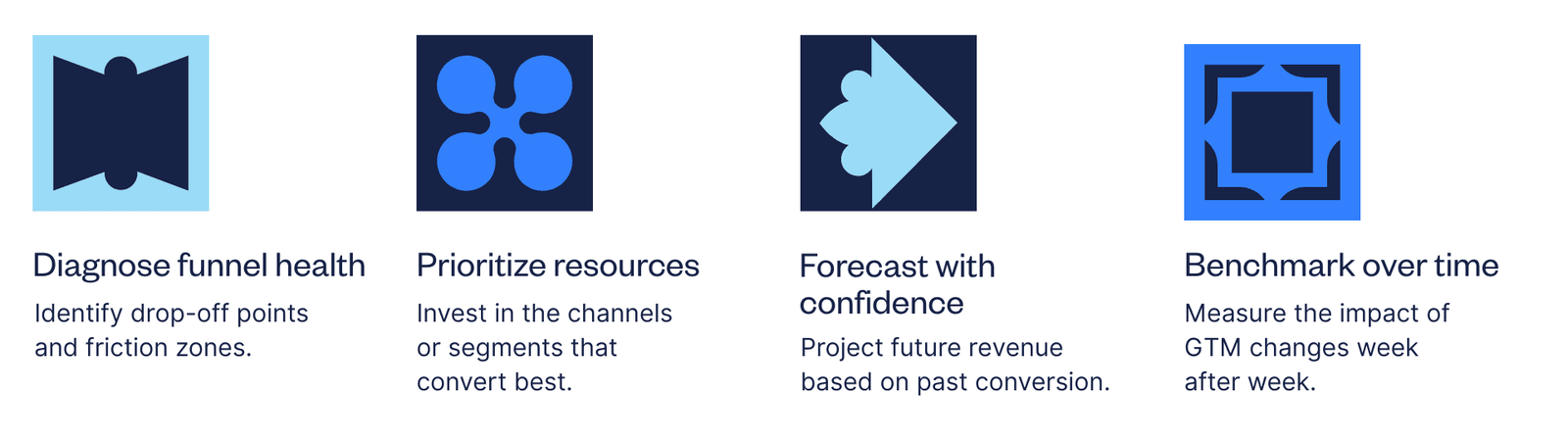
In short: without reliable conversion rates, you’re flying blind.
The many ways to calculate conversion rates
Here’s where things get tricky. There isn’t just one way to measure a conversion rate. Depending on your funnel structure, sales cycle, and data availability, different methods apply:
- Absolute Conversion Rate: best for quick snapshots or directional insights.
- Cohorted Conversion Rate: best for comparing sources or periods over time.
- Reversed Cohort Conversion Rate: best when sales cycles are long and you need to correct lag.
- Active Based Conversion Rate: best for short-term performance checks and weekly reviews.
- Ratio Conversion Rate: best for stabilizing results quickly as deals reach an outcome.
- Aggregated Conversion Rates: best for high-level reporting across channels or time periods.
Conversion rate cheat sheet
Get the cheat sheet to see how each conversion rate method works, with definitions, formulas, and pros and cons.
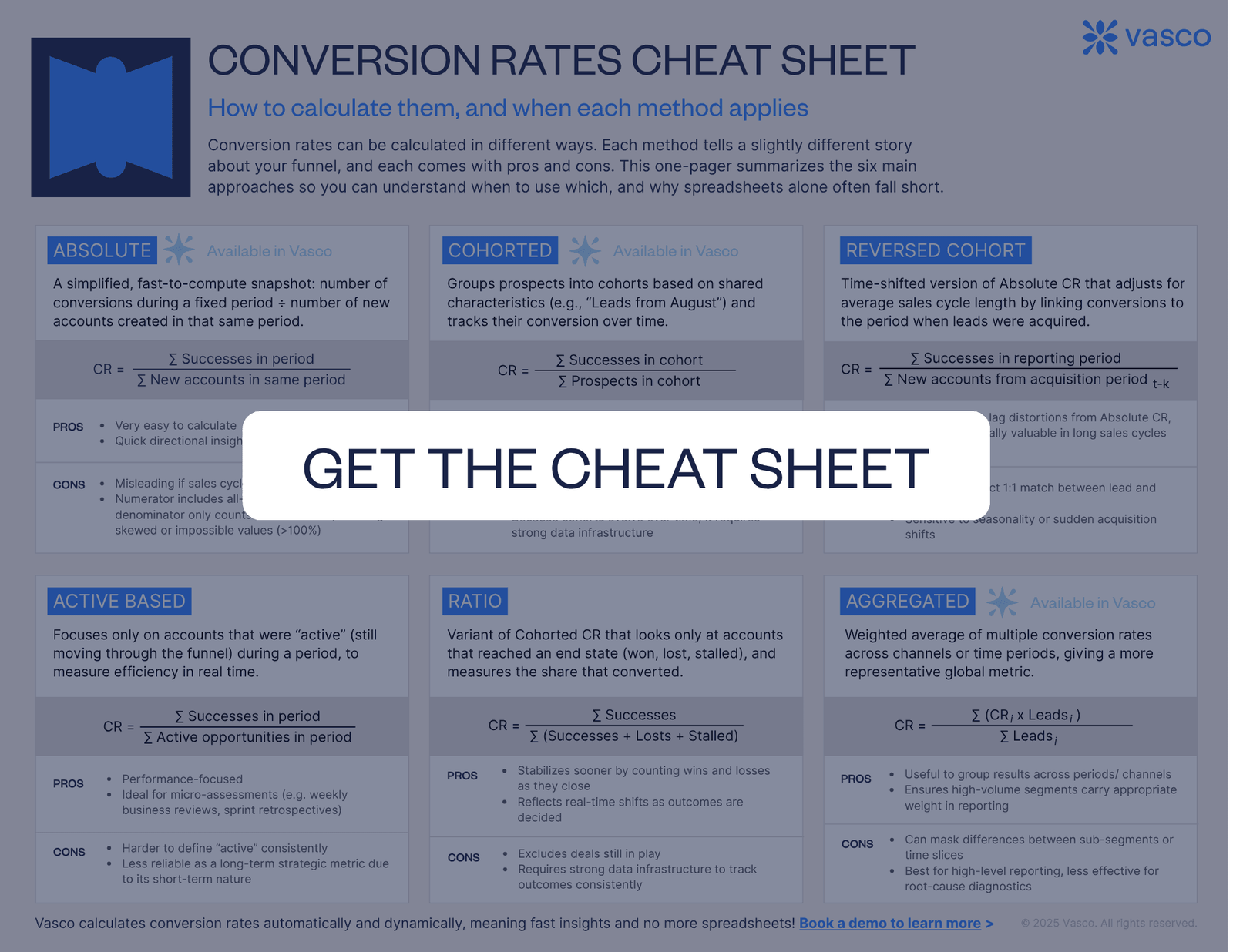
The key insight: it’s all about the denominator. Are you counting against new leads, total active pipeline, or accounts that have reached an outcome? Different denominators lead to very different stories.
Why spreadsheets won’t cut it for conversion rates
Technically, you can start with a spreadsheet, and for a while, it works. But as soon as your funnel gets more complex (think multiple channels, varying sales cycles, overlapping cohorts…) the math gets out of control.
Problems you’ll run into:
- Time lag distortion: conversions don’t happen in the same period as acquisition.
- Denominator mismatch: counting against the wrong population leads to inflated or even impossible numbers (>100%).
- Inconsistent definitions: each rep or team calculates things differently.
- Manual upkeep: hours spent cleaning and importing data from multiple tools, with no automatic flow-in. The result: conversion rates are always lagging instead of real-time.
In a spreadsheet, every assumption or formula tweak introduces new risks. And by the time the numbers are ready, they’re already outdated.
The Vasco approach
At Vasco, we believe conversion rates should be:
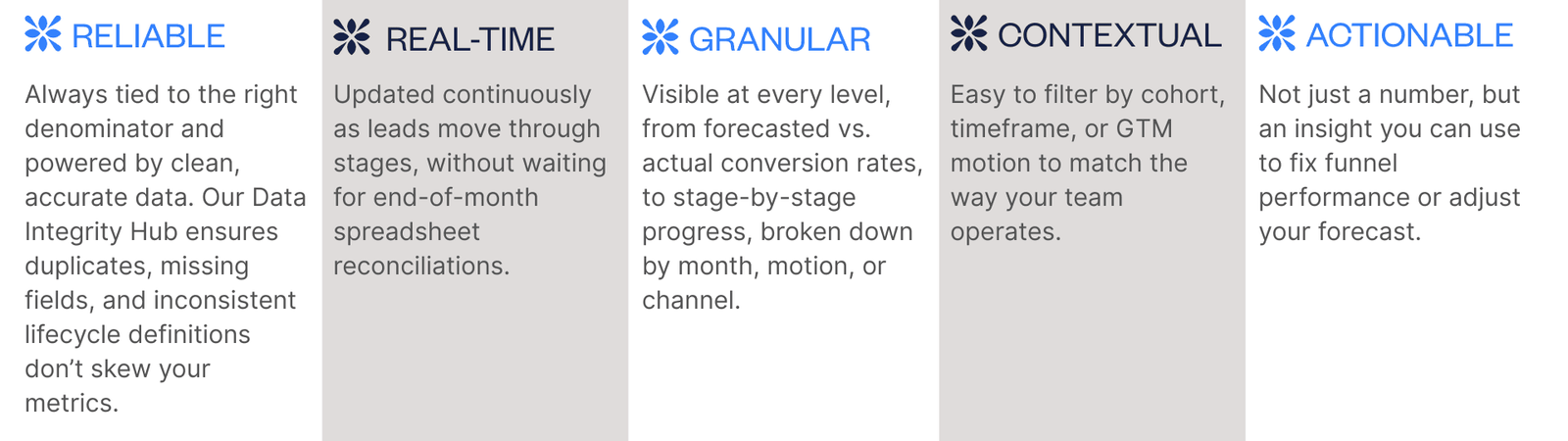
With Vasco, conversion rates are always tied to the right methodology, without manual formulas or reconciliations. That means you get conversion rates you can trust.
Final thought
More than just metrics, conversion rates are the lens through which you evaluate efficiency, effectiveness, and momentum.
But their usefulness depends entirely on how they’re defined and applied. Get them wrong, and your strategy falters. Get them right, and they unlock predictable, scalable growth.
That’s why Vasco makes conversion rates not only accurate, but effortless!