2026: the year of compound growth
For more than 15 years, SaaS companies optimized people-based funnels — improving CR2, tightening handoffs, and specializing roles — until that model hit a structural ceiling. SaaS reached the limits of human productivity.
But AI breaks through it.
In this new context, efficiency is measured by the ratio of compounding to cost: whether outputs are feeding inputs faster than marginal cost is rising. Once you see growth as a system to be designed instead of a funnel to be staffed, 2026 marks a true inflection point.
Compound growth is not a tactic or an outcome. It is an advanced growth state of a system—one in which outputs reliably feed future inputs faster than marginal cost increases, creating self-reinforcing momentum.
From linear funnels to compounding systems
The question is no longer how much more output can be extracted from the funnel, but how systems can be configured to compound.
Traditional go-to-market motions were built as linear systems. They required constant energy input to generate output, and they decayed the moment that input stopped. Compounding systems behave differently. When designed correctly, the output of one cycle becomes the input of the next.
This shift from linear productivity to compounding systems sits at the core of how RevOps evolves in 2026.
The operating layer becomes the breakthrough
The biggest RevOps breakthrough in 2026 will not happen in the data stack or in team alignment. It will happen in the operating layer that sits between them.
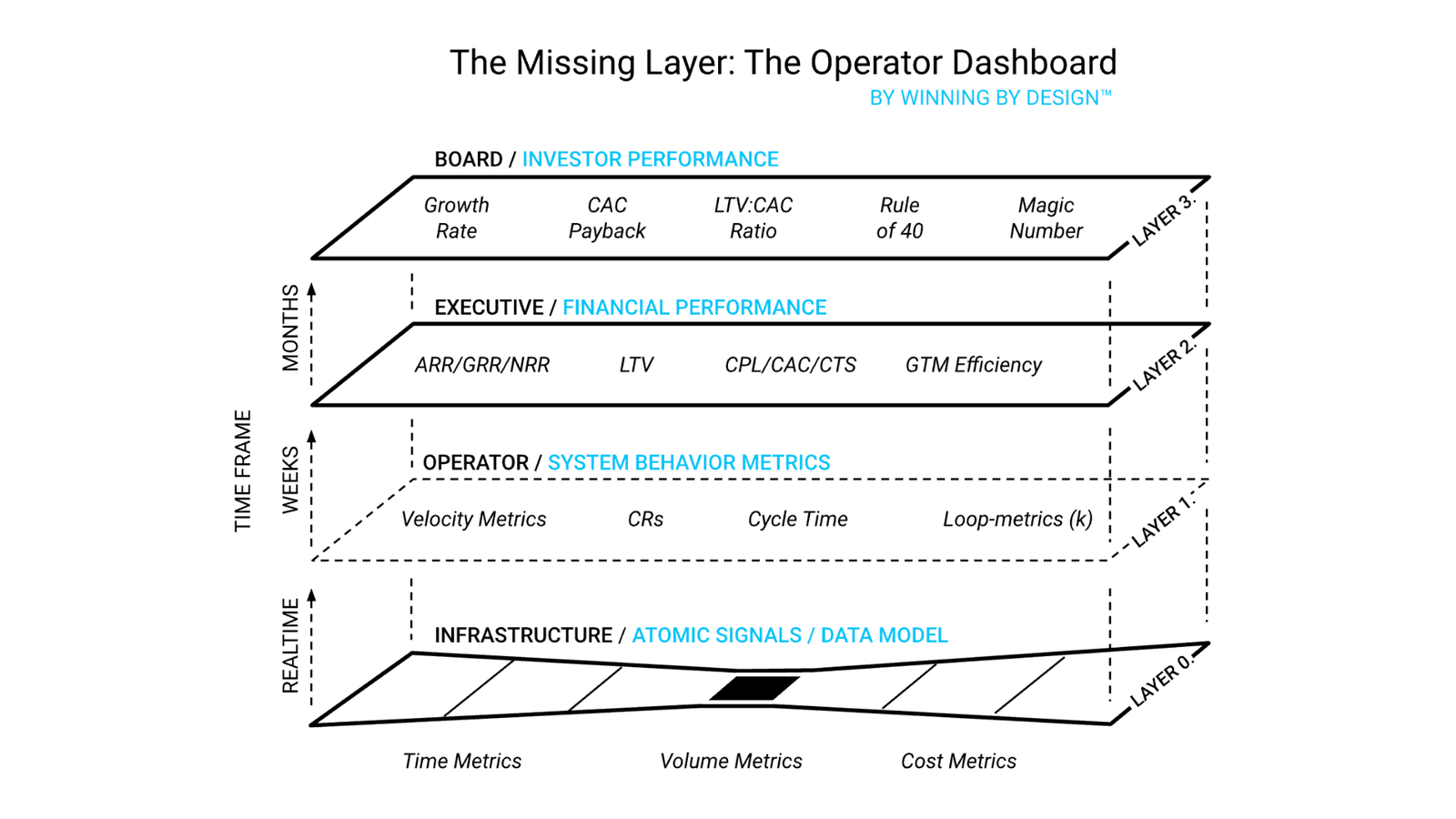
This operating layer is built on real-time data and atomic signals that reveal how the system is behaving: velocity, conversion dynamics, cycle-time, and early signs of growth loop decay. It becomes the bridge between infrastructure and financial performance.
With this layer in place, AI can generate real-time insights on system behavior — not just analyze what happened last quarter — enabling decisions at the same cadence that growth happens. This shift sets the stage for AI’s deeper role inside RevOps.
AI turns RevOps into a growth science
AI has not simply made RevOps faster. It has fundamentally changed the job.
Today’s market is defined by constraints, limited demand, finite resources, and real tradeoffs. In this environment, RevOps moves from capacity planning to growth planning: not “How do we process what’s coming in?” but “What growth is achievable with what we have?”
This is where AI becomes transformative. AI can model the system in real time and simulate thousands of growth trajectories. It automates tasks. More importantly, it reveals the mechanics of compounding and decay.
"AI is turning RevOps into a science, not just an operations function." — Jacco van der Kooij
Why growth loops outperform channels
In 2026, the most effective go-to-market “channel” will not be a channel at all. It will be a growth loop.
Traditional channels like outbound, paid, and inbound behave as open systems: energy goes in, output comes out, and the motion decays when the input stops. AI-era GTM favors growth loops, where the output of one cycle becomes the input of the next.
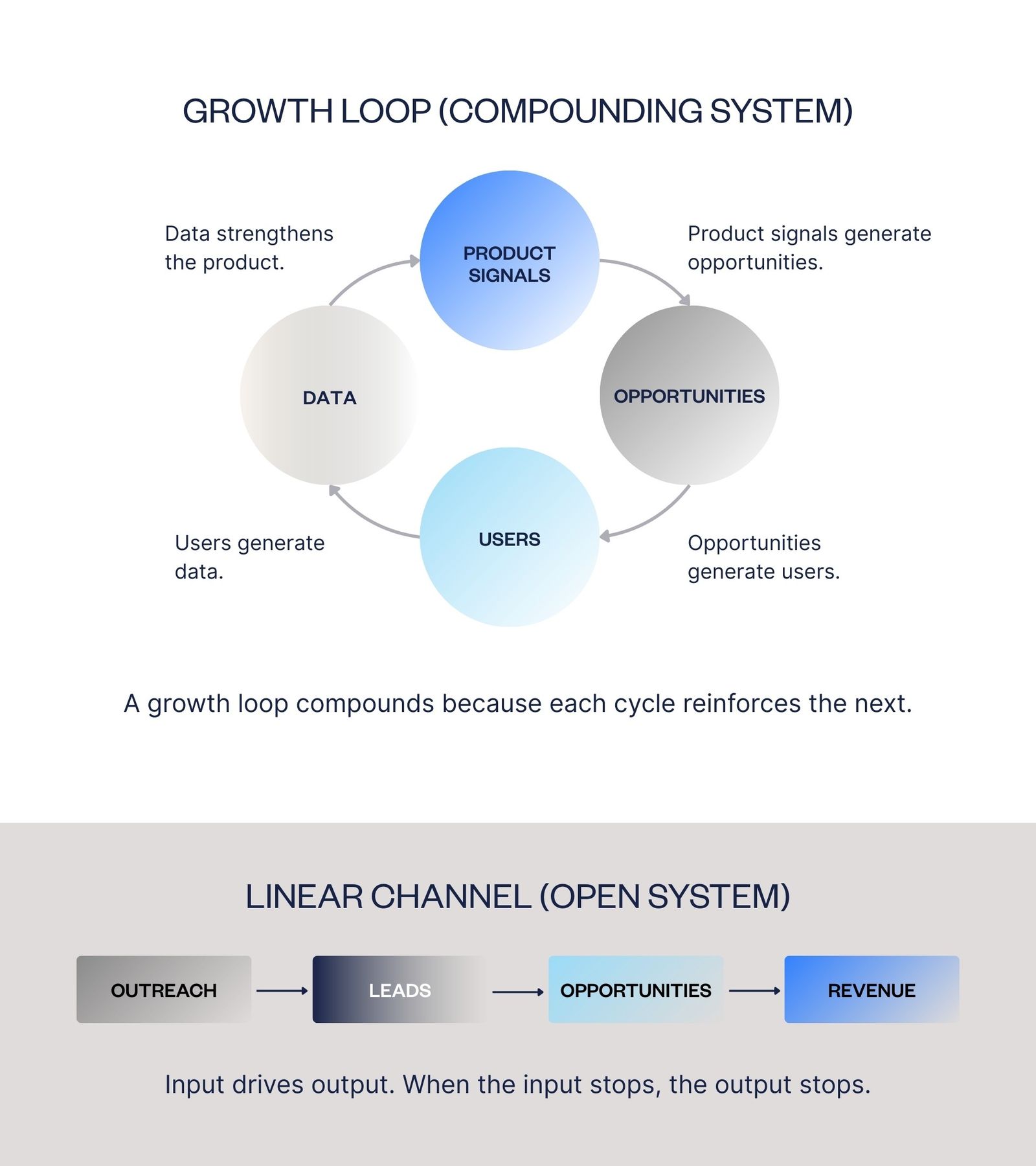
Product signals generate opportunities. Opportunities generate users. Users generate data. Data strengthens the product. That loop compounds while channels eventually saturate.
A growth loop outperforms any channel because it compounds growth without compounding cost and shortens cycle time — both signatures of 2026 growth engines.
"A growth loop is growth that creates growth." — Jacco van der Kooij
RevOps becomes the architect of growth
RevOps may remain the name of the role, but growth architecture becomes the core of the job.
In 2026, RevOps is responsible for architecting how the business grows: the loops, the instrumentation, the cycle-time, the compounding logic, and the health of the system itself.
The single capability that differentiates RevOps is the ability to use AI — paired with the methods of revenue architecture and growth architecture — to run simulations, not forecasts. Simulations reveal the probability of hitting targets, show where growth will actually come from, detect where decay begins, and expose how different levers influence compounding.
"The system tells us where growth will come from — if we are willing to listen." — Jacco van der Kooij
Taken together, these shifts fundamentally redefine the RevOps mandate.
Why forecasting must be rebuilt from scratch
If one process must be rebuilt in 2026, it is forecasting.
Traditional forecasts assume linearity in a world defined by nonlinear systems. They treat growth as a static funnel instead of a dynamic engine with acceleration, drag, decay, and compounding effects.
Forecasting must evolve into growth modeling. Using AI, teams can simulate thousands of system states, understand the probability of hitting targets, identify where compounding is emerging, and detect where decay begins months before it appears in revenue.