Over the past decade, I've scaled revenue teams through hypergrowth, the kind where something breaks every quarter because you're moving too fast to fix it. And I've learned this: when growth outruns enablement, even your best people hit a wall.
The invisible bottleneck
You scale fast. Activity spikes. Dashboards light up green. Leadership celebrates. But something feels off. Deals take longer to close. Pipeline quality drops. New hires take twice as long to ramp as your first few reps did.
A pattern emerges: three top performers carry the entire number while everyone else treads water. You hire more people. The problem gets worse.
The instinct is to move faster. More activity, more coaching, more urgency. But speed doesn't fix broken systems. It amplifies them.
The breakthrough comes when you stop asking "who's not performing?" and start asking "what's actually breaking?"
Almost always, it's not effort. It's enablement: teams scale, systems don't.
What good looks like (and how to steal it)
Walk into most sales orgs and you'll hear the same thing: "Only Sarah knows how to position that." "Only Eric knows how to sell that product." "Only Jen closes enterprise deals."
This is a red flag dressed up as a compliment.
Real enablement isn't more training decks or lunch-and-learns. It's the infrastructure that captures what works and makes it repeatable across your entire team, not just your top performers.
Here's what changed things for us:
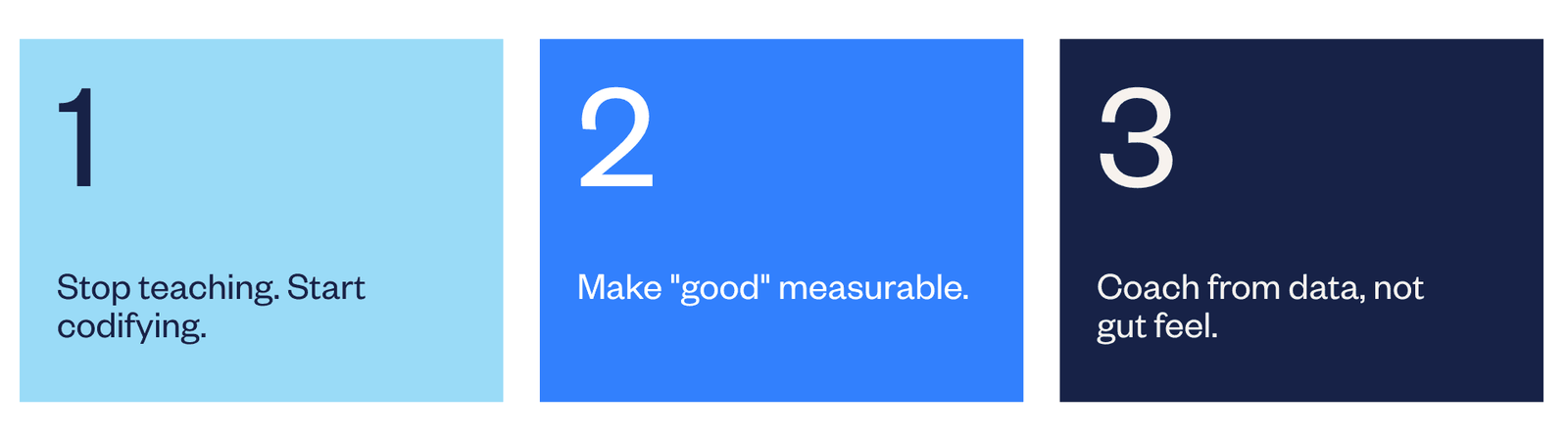
- Stop teaching. Start codifying. We didn't create more content. We extracted the frameworks our best reps were already using. Their cold call structure, their discovery questions, their objection responses. Then we enhanced those frameworks and made them simple enough for anyone to follow.
- Make "good" measurable. We built lightweight rubrics for every critical conversation. Not 47-point evaluation forms. Three to five key behaviors that separated great calls from mediocre ones. Things like: "Did they add business context in the first 90 seconds?" "Do they understand the business problem that needs to be solved?"
- Coach from data, not gut feel. We stopped relying on intuition and started analyzing actual calls from top performers. What did they say? When did they say it? What happened next? Patterns emerge, and they were often counterintuitive.
The result? Conversation-to-meeting rates and pipeline velocity jumped.
But the most important insight wasn't what we taught. It was what we finally understood about how deals actually get won.
The multithreading breakthrough
Jim was stuck. Great rep, strong relationships, always in the deal. But his close rate was well below average.
When we analyzed his deals, the pattern was obvious: he had one champion in every account. Just one. When that champion got pulled into another priority, the deal stalled. When they left the company, the deal died.
We didn't need to teach Jim new skills. We needed to change one behavior: intentional multithreading from the first call via buyer enablement.
By the next quarter, Jim's close rate jumped by 40%.
That's what enablement does when it works: it finds the one thing that amplifies everything else.
The AI acceleration layer
Here's where we hit a new problem: the system worked, but it didn't scale. I couldn't manually review every call. I couldn't spot every pattern. I couldn't coach an entire team with the same depth I could coach two.
We needed to capture what was working and distribute it faster than I could do manually.
That's where AI stopped being hype and started being useful.
We didn't use AI to replace coaching. We used it to make coaching more precise. Here's the exact process:
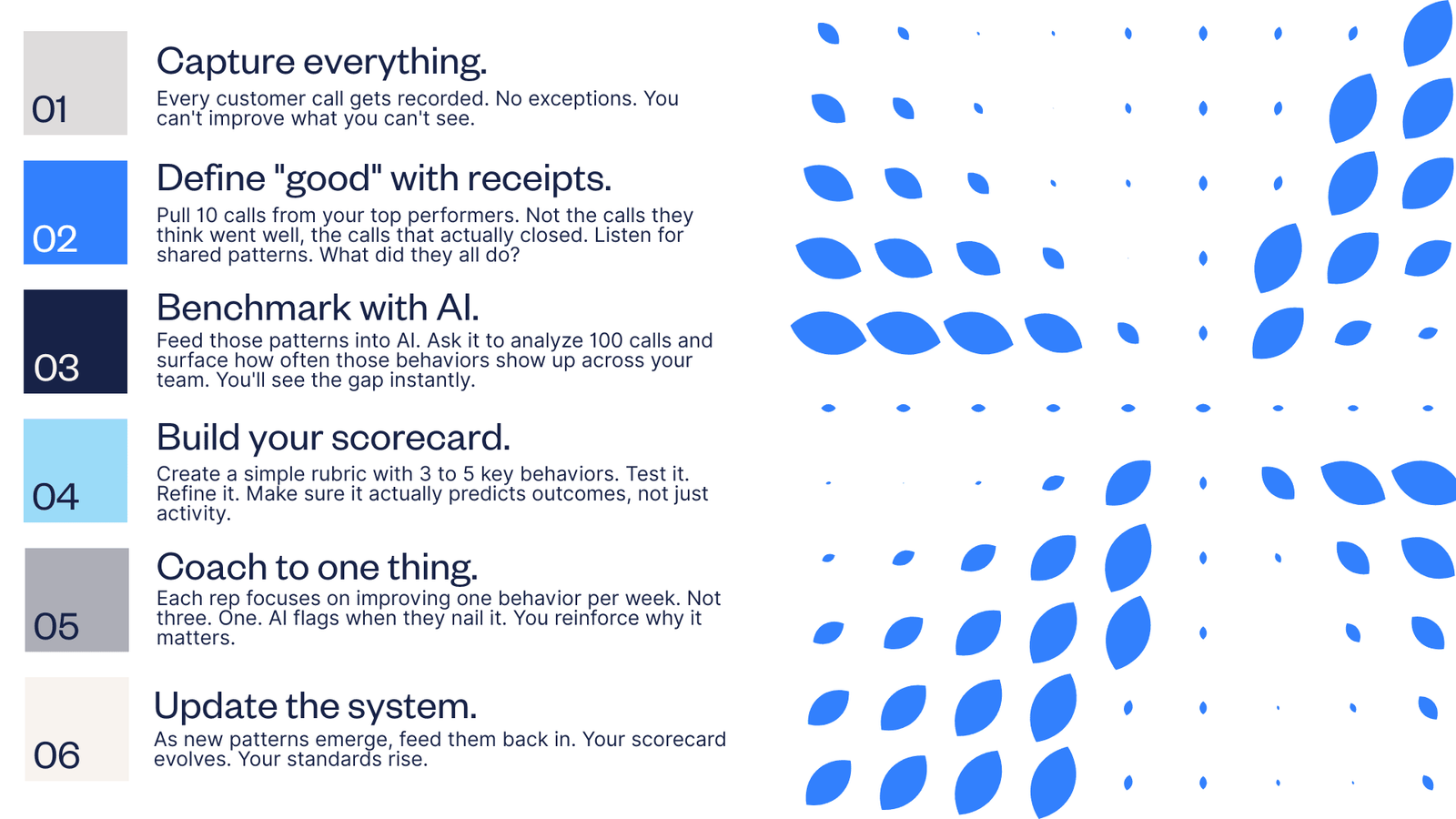
1. Capture everything. Every customer call gets recorded. No exceptions. You can't improve what you can't see.
2. Define "good" with receipts. Pull 10 calls from your top performers. Not the calls they think went well, the calls that actually closed. Listen for shared patterns. What did they all do?
3. Benchmark with AI. Feed those patterns into AI. Ask it to analyze 100 calls and surface how often those behaviors show up across your team. You'll see the gap instantly.
4. Build your scorecard. Create a simple rubric with 3 to 5 key behaviors. Test it. Refine it. Make sure it actually predicts outcomes, not just activity.
5. Coach to one thing. Each rep focuses on improving one behavior per week. Not three. One. AI flags when they nail it. You reinforce why it matters.
6. Update the system. As new patterns emerge, feed them back in. Your scorecard evolves. Your standards rise.
The breakthrough wasn't the technology. It was turning what top performers do instinctively into something the whole team could learn.
Even perfect systems fail without buy-in
Reps can tell when leadership is checking boxes versus solving real problems. They've sat through enough "transformational" training to be skeptical.
Here's what actually works:
- Start with their goals, not yours. What are their goals? What's blocking them? What would make their job easier? Build enablement around their answers, not your assumptions.
- Show, don't tell. Don't pitch AI as magic. Show them one call where it flagged something they missed. One insight that changed a deal. One behavior that's working for someone else on the team.
- Lead with the pacesetters. Let early adopters prove the value. When the rest of the team sees their peers winning faster, they'll want in.
AI should amplify relationships, not replace them. When people feel supported rather than surveilled, adoption follows naturally.
The new growth equation
The old playbook doesn't work anymore: hire fast, sell harder, fix problems later. Modern buyers are too sophisticated and teams are lean.
Sustainable growth comes from a different approach:
Enablement = Making what works visible + shareable + repeatable
Data shows you what's working, coaching makes it shareable, and AI makes it repeatable at scale.
But here's the part people get wrong: you can't retrofit this. You can't bolt enablement onto a broken system and expect it to work.
You build the scaffolding before you scale, codify success before you hire the next 10 reps. You nail your frameworks before you expand to new segments. You earn the right to grow by proving your system works with the team you have today.
That's the difference between companies that scale successfully and companies that just get bigger and messier.
Build the scaffolding early. Make every person on your team effective.
Give them the clarity, tools, and confidence to win without constant oversight.
That's how you scale. Not just revenue, but repeatability.