What you’ll find in this guide
This guide is structured around three sections, designed to move from foundations to execution:
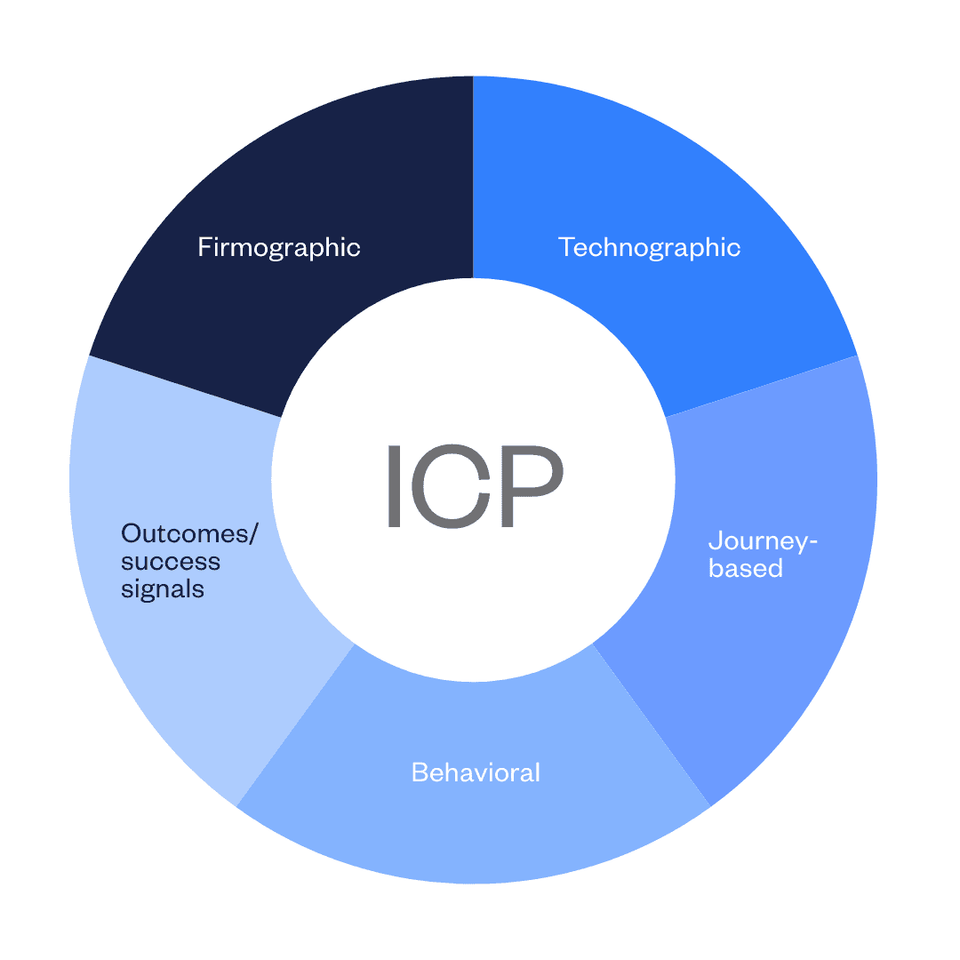
- ICP fundamentals – what an ICP is made of today and why it’s inherently multidimensional
- ICP across maturity phases – how ICP approaches evolve with scale, data, and GTM complexity
- Making ICP operational – embedding ICP into execution, measurement, and feedback loops
The four ICP maturity phases
At the core of the guide is a practical framework built around four common ICP maturity phases. Each phase reflects a different operating context, data reality, and level of GTM complexity.
- Hypothesis-driven ICP – Typical of early-stage or high-ACV motions, where ICP is shaped primarily by founder intuition, early deals, qualitative insight, and leading signals rather than validated outcomes.
- Outcome-driven ICP – As customer volume grows, ICP becomes grounded in post-sale success patterns like retention, expansion, time-to-value, and deal quality, helping teams focus on segments that create durable value.
- ICP as a portfolio – At scale, multiple ICPs or micro-ICPs coexist. Teams formalize feedback loops, optimize what works, and deliberately explore new segments without losing focus or consistency.
- Adaptive ICP system – In large, complex organizations, ICP becomes an always-on system that continuously ingests signals, detects shifts, and actively coordinates GTM decisions across motions, segments, and teams.
A practical guide, not a one-size-fits-all framework
The goal isn’t to prescribe a single “best” ICP model, but to help you recognize where you are today and apply the right level of ICP sophistication for your GTM motion.
Used well, ICP becomes a shared system that aligns teams, guides execution, and evolves as your business grows.