
After working with hundreds of post-seed companies, I’ve seen the same pattern over and over. The winners treat scaling like a science. The rest confuse early momentum with readiness. So let’s talk about when you’re actually ready to scale.
Product-market fit is not a feeling
Ask a room of founders what product-market fit means, and you’ll get a hundred different answers. Some say $500k in ARR. Others say “six happy customers.” Or a steady stream of inbound leads.
Those are good signs, but they measure market-message fit, not product-market fit. Being good at sales or marketing can get you contracts, even if customers don’t truly need what you sell. That’s selling ice to Eskimos.
If you want a quantifiable definition, it’s simple: retention. When customers stay, expand, and get ongoing value, you’ve built something real. I like to see net dollar retention above 100 % before declaring product-market fit. Otherwise, you’re just filling a leaky bucket.
The problem: retention is lagging
In early-stage SaaS, you can’t wait twelve months to see who renews. You need a leading indicator of retention, a way to know today if customers will stick tomorrow.
Here’s the framework I use:
P % of customers do E event every T time
Three variables:
- P = the percentage of customers
- E = the key event that signals value
- T = the time window
That’s your Leading Indicator of Retention (LIR).
Examples of LIR in action
- Slack: 70 % of customers send 2,000 messages per month.
- Dropbox: 85 % of customers back up their device every day.
- HubSpot: 80% of users adopt 5 or more features in a 25-feature platform.

Those companies didn’t set revenue goals like “hit $1 million ARR.” They set usage goals like “get 70 % of customers sending 2,000 messages.” That second goal builds a foundation you can actually scale.
You don’t need regression analysis to start. Just track, cohort by cohort, what percentage of new customers hit your event in month 1, 2, 3… and keep pushing that number up. When it climbs and stays there, you have real product-market fit.
From product-market fit to go-to-market fit
Even then, you’re not ready to scale yet. Product-market fit proves that customers find value.
Go-to-market fit proves you can deliver that value profitably and repeatedly.
The metric for that is unit economics: your CAC, LTV, and payback period. But again, those are lagging indicators. You need to extract them into variables you can measure today: average deal size, close rate, sales cycle, cost per lead, rep ramp time.If the algebra behind those numbers works out to a healthy LTV : CAC > 3, you’re on the right path.
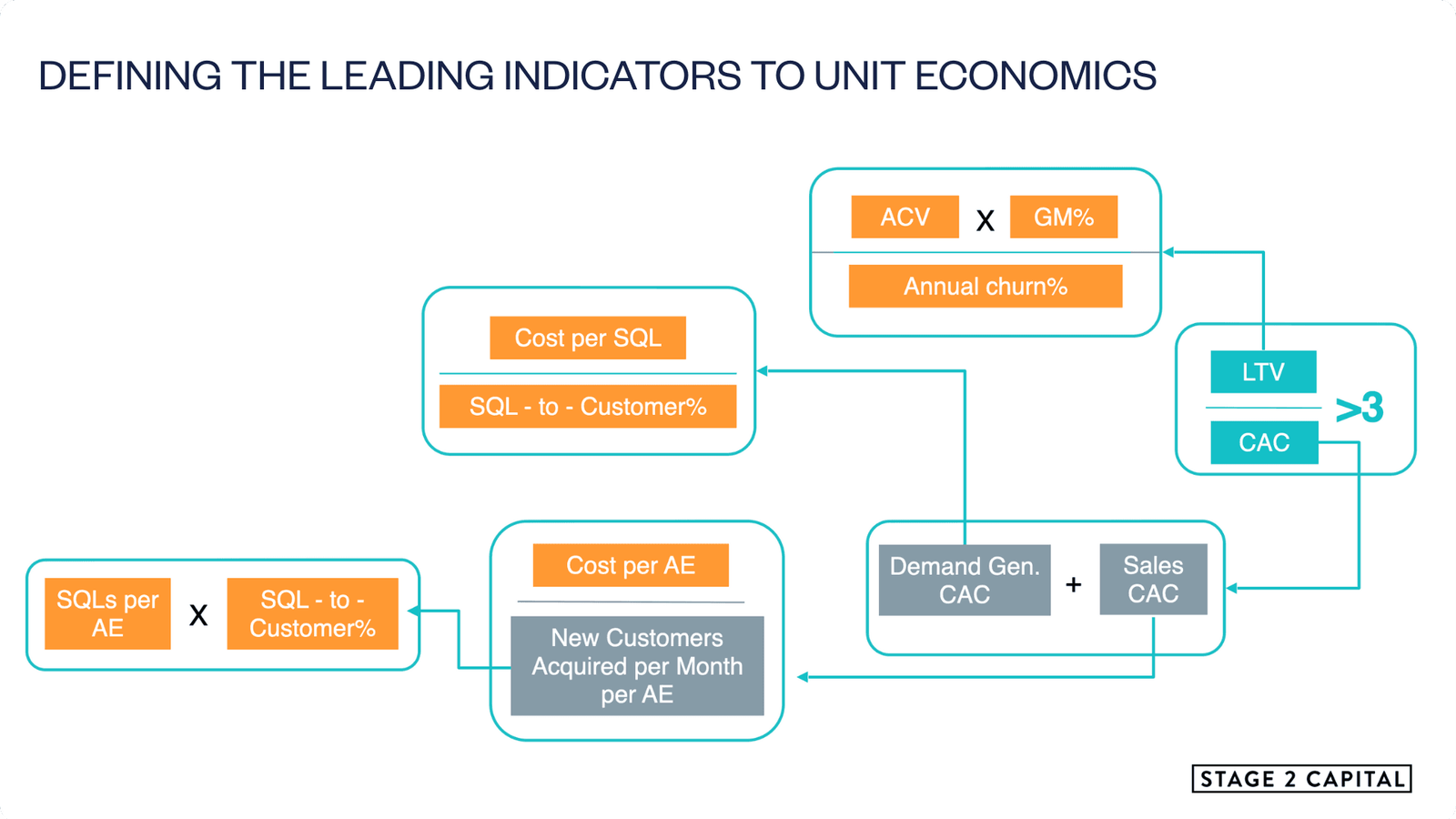
The key is sequencing. Work on product-market fit first, then go-to-market fit. If you optimize both at once, you risk building a repeatable motion on the wrong market.
Scaling is a pace, not an event
When both fits are in place, the next question is speed. How fast do you scale?
Most companies treat it like a light switch: raise capital → hire 20 reps.
That’s not scaling, that’s gambling.
Think of it as pacing.
Maybe start with two reps every other month.
Watch your leading indicators of retention and unit economics.
If both stay green for six months, double the pace.
If they turn red, slow down, fix it, then accelerate again.
Those metrics become your speedometer. Many startups only realize they were going too fast when churn hits nine months later. You’ll know nine months earlier.
How to operationalize the science of scaling
- Define your LIR (the single behavior that predicts retention).
- Instrument it in your product logs.
- Track cohorts monthly until the trend line turns upward.
- Back-solve your unit economics into present-day controllables.
- Scale gradually, using your LIR and unit-econ dashboards as the green light.
Do that, and you won’t need to argue with your board about whether you’re ready to scale. You’ll have data that speaks for itself.
Final thought
Product-market fit proves you’ve built something people need. Go-to-market fit proves you can deliver it efficiently. Scale only when you have both, and let retention, not revenue, tell you when that day has come.