A 15-person startup and a 400-person scale-up need completely different RevOps strategies. Build too much too early and you're maintaining infrastructure nobody can trust. Wait too long, and the technical debt compounds faster than you can fix it.
Gartner predicts 75% of the highest-growth companies will run a RevOps model by 2026, but keep in mind that adoption isn't the same as effective execution.
As Guillaume Jacquet, CEO of Vasco, puts it:
"Getting from $1M to $10M in ARR is "20% magic and 80% is a paved road.”
The paved road is in your control, and building the right infrastructure for your unique GTM plan is what will create more of the magic you need to distinguish your business in the market.
Before diving into the stages, let’s cover one prerequisite that runs through all stages, and why most companies only discover it when it’s too late.
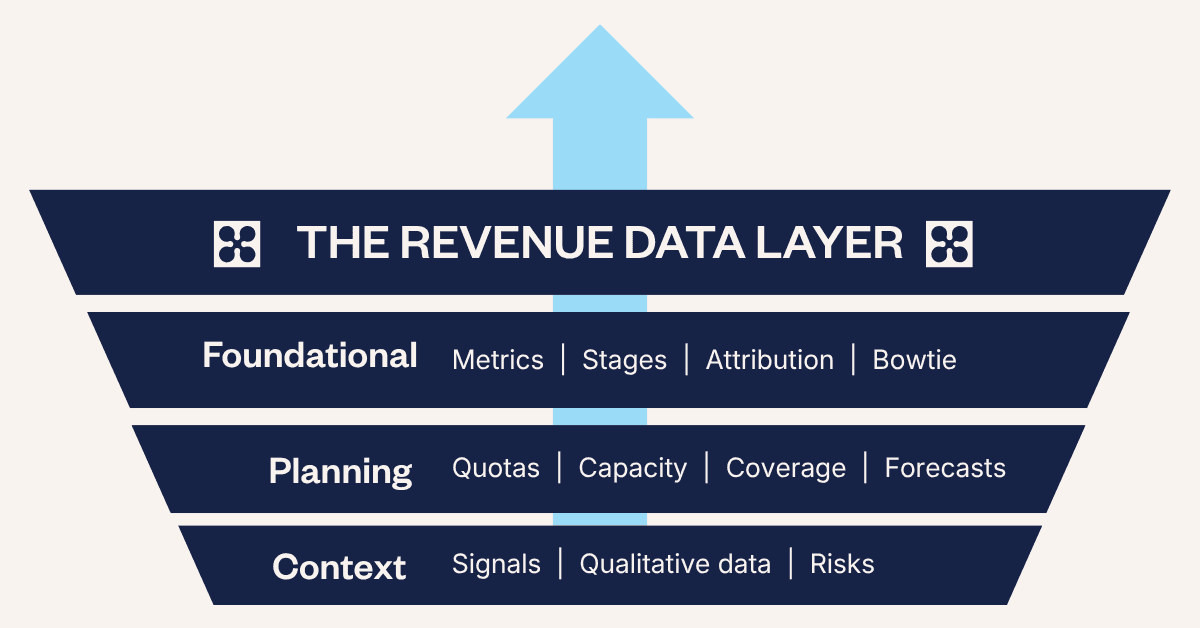
The hidden prerequisite at every stage: Your revenue data layer for AI tools
Every stage of RevOps maturity described below shares one underlying requirement of structured, clean data that reflects how your business actually works.
Your ICP tiers, lifecycle stages, channel definitions, and revenue taxonomy are the foundation that determines whether AI tools like Claude Cowork can accurately reason about your business or just make the best guess.
Guillaume explains:
"If you don't have that data layer for AI to reason on, it's going to reverse-engineer a plausible answer every single time you ask it a question. At any company size, that doesn't get you to a production-ready RevOps stack."
You don't need a full RevOps team to build this foundation right. The right platform gives early-stage founders the structured revenue data layer out of the box: pre-configured ICP tiers, lifecycle stages, and revenue taxonomy that's ready to scale with you.
The work you do at each stage builds the layer that makes the next stage possible, and the right tooling means you're not starting from scratch every time.
The 4 stages of RevOps by company size
RevOps evolves across four stages:
- Foundational (Pre-Seed to Series A)
- Formalizing (Series B)
- Scaling (Series C–D)
- Optimizing (Series E+)
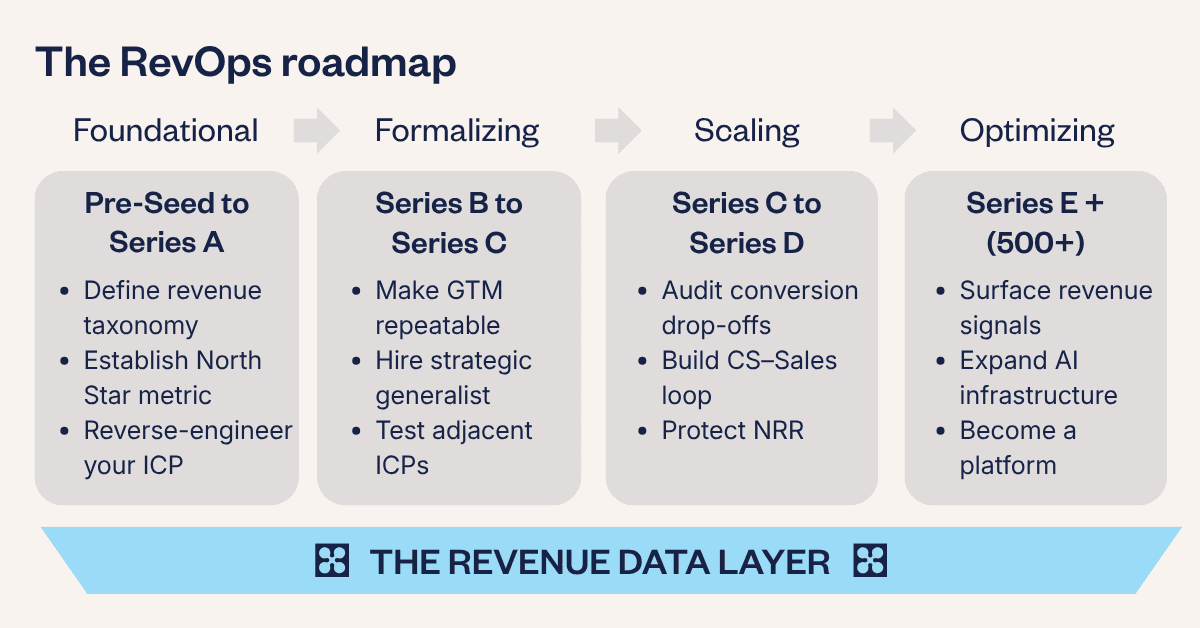
At each stage, the focus shifts from building clean foundations, to operationalizing the GTM motion, to eliminating revenue leakage, to running RevOps as a fully strategic, AI-enabled function.
Stage 1 | Pre-Seed to Series A: Build the foundation
RevOps owner: The founder or Head of Sales (and likely three other jobs)
In stage one, a CRM exists, but adoption is inconsistent. Marketing and Sales are tracking success with different numbers. Forecasting is a gut feeling with a spreadsheet attached to it.
This is a trap most founders fall into at this stage. They assume they can replicate what got them to $1M ARR. They hire a few salespeople, hand them a quota, and expect the same results. It doesn't work, because what got them here was less systems thinking and more founder-led instinct.
The #1 priority is your data structure
How you set up your CRM, define your lifecycle stages, and name your campaigns today will determine how fast you can scale 18 months from now. Technical debt at this stage is quiet. It doesn't hurt until it suddenly does, all at once, right when you're trying to close a Series B.
Three things to do now:
- Define your revenue taxonomy: Before you have 10 reps doing it differently, map out your lifecycle definitions, opportunity stages, channels and what information is relevant at each step of the journey.
- Pick one North Star metric that aligns GTM teams: Choose pipeline coverage, CAC payback or any metric that bridges accountability. Just one number, shared by everyone.
- Resist living in too many tools: Your CRM, spreadsheets and other tools prevent you from end to end analysis of your pipeline data.
Your data structure is your AI foundation
Most early-stage teams assume a revenue data layer is something you earn later, once you have the data volume and the team to build it. It's not. The context you configure now (ex. lifecycle stages, field definitions, a single source of truth) makes a context graph possible from day one. Get this wrong, and AI will reason on your business incorrectly.
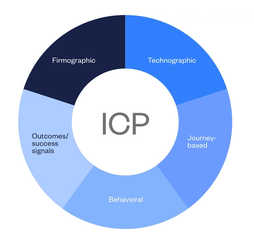
For seed to Series A companies, this foundation also shapes your understanding of your ICP, including what resonates, at which stages, which questions to ask, and which profiles are worth pursuing. That clarity comes from configuration, not volume.
Building a revenue engine that doesn't depend on you starts with getting your pipeline back under control. And when the system runs predictably, you're not stepping back. You're finally stepping into the role the business actually needs from you.
Stage 2 | Series A to Series B: Operationalize the GTM motion
RevOps owner: To be determined
The GTM motion is no longer founder-led, nor is it documented. Leads fall through handoffs, reps run their own process, and the board wants a forecast you can't confidently give.
Marketing blames Sales for not following up. Sales blames Marketing for bad leads. But the real problem is nobody has defined what a good lead, a clean handoff, or a qualified opportunity actually looks like.
When everyone owns the whole funnel, the urgent always beats the important.
The #1 priority is making the GTM motion repeatable
Getting from $2M to $10M means codifying playbooks, specializing roles, and normalizing processes, so that adding headcount produces predictable output. Conversion rates are known, and every call looks like a variation of the last.
The critical nuance: build around more than one ICP. You'll hit saturation faster than you think.
Here are two strategies to make it happen:
- Test adjacent ICPs and motions now, and be sure to keep them strictly segmented. If you blend them into your core data and your unit economics will look like they're falling apart when they're not.
- Segment performance data by GTM motion and ICP so you can tell which new bets to accelerate and which to cut.
A repeatable GTM motion means documenting every handoff from first touch to CS, defining SLAs between teams, and building one reporting layer that leadership actually trusts.
What to look for in your first RevOps hire
Look for a strategic generalist. This person should feel confident owning CRM hygiene on Monday and sit in the room when GTM strategy is being set on Tuesday.
The biggest mistake at this stage is hiring a systems administrator when you need an operator. Tactics can be learned, but strategic thinking can't be trained in.
Build for scale, not for show
Your core stack at Series B should be CRM + RevOps automation + a CS platform. Every tool you add beyond that needs a documented owner, a clear use case, and a defined integration. Addition without integration is just expensive noise.
Clean handoff data is what makes AI actionable
As you continue to grow, the revenue data layer starts connecting GTM motions, including who touched a lead, when, and what happened next. That handoff data is what allows AI to help your team identify where deals are stalling and where follow-up is falling through. It gives your first RevOps hire high-impact suggestions to protect your pipeline.
Stage 3 | Series B to C: Prepare for market expansion
RevOps Owner(s): Expands to a team of 2–4 specialists
Getting from $10M to $50M requires multiple ICPs and motions, and a single one won't carry you there. This is where many companies lose steam. You need segmented data to iterate on new markets and channels without degrading what's already working.
Stage three usually sees roles begin to split into specializations. Sales Ops, Marketing Ops, CS Ops begin to tie forecasting to board packages and investor reporting. The question is no longer "are we aligned?" It's "where are we losing revenue, and why?"
Pro tip: At this stage, most companies discover that their funnel looks healthy at the top and disappointing at the bottom. The delta lives in conversion leakage, where deals stall between stages, poor handoffs eroding CS expansion, and forecast inaccuracy that makes planning unreliable.
The #1 priority is auditing your funnel for conversion drop-offs
Build a structured feedback loop from CS to sales so expansion and retention data flows back into how you qualify and close.
This is also the stage where your ICP needs to move from a static definition to something your whole GTM motion is actually running on.
The companies that get this right treat ICP as a living system, not a document. Growing ARR is important, but protecting NRR is what will strengthen your pipeline.
In fact, it’s essential to protect NRR, and aggressively. Ultimately, you can acquire customers all day, but if your existing base is shrinking, then you're filling a leaky bucket. The goal is net revenue retention above 100% (and ideally 120–140%), so that a meaningful portion of net new revenue comes from expansion and acquisition.
At Series C, investors stop accepting "we think" and start demanding "we know." RevOps is what turns anecdotal pipeline updates into concrete conversion rates, velocity data, and forecast accuracy.
Structure your team for healthy growth
The right leaders for this stage make everyone around them better. Decide between a centralized RevOps team and embedded ops specialists early. Changing this later is disruptive and expensive.
Pro tip: This is also the stage where RevOps needs a direct line to Finance. Revenue planning, headcount modeling, and territory design all live at that intersection.
Don't migrate your CRM…yet
This is when CRM migration conversations start happening. In most cases, optimizing your existing CRM is smarter than rebuilding. Migration costs are almost always underestimated. Revenue intelligence tools start to earn their keep here, particularly for forecasting accuracy and pipeline inspection.
AI surfaces the leakage your funnel reports can't see
Conversion leakage rarely shows up cleanly in a dashboard. A structured revenue data layer gives AI the full picture, including deal history, handoff timing, CS health signals. This way, it can identify exactly where revenue is slipping and why, rather than surfacing a drop-off you still have to diagnose manually.
Stage 4 | Series E+ and Enterprise: Run RevOps as a revenue system
RevOps is a fully specialized organization of Forecasting Analysts, Systems Architects, Enablement Program Managers. AI-assisted forecasting and revenue intelligence are standard. RevOps is a strategic peer to Finance, not a downstream support function.
The #1 priority is moving from reactive reporting to proactive revenue signals
The best enterprise RevOps teams are surfacing what's about to happen and giving GTM leaders enough lead time to act on it. Multi-touch attribution across complex, multi-channel motions is expected. Manual reporting is a solved problem.
Expand your AI infrastructure
This is where it gets interesting. AI is reshaping how revenue is planned, modeled, and acted on in real time. The teams investing in AI governance and automation infrastructure now are building a compounding advantage for fundamentally better decision-making loops between data, strategy, and execution.
AI can model revenue decisions before you make them
At this stage, the revenue data layer is deep enough to do something earlier stages can't: run scenarios. Before committing to a new territory, a headcount change, or a pricing move, AI can model the likely revenue impact across every GTM motion. The teams building this capability now are making fewer mistakes and compressing the time between insight and decision.
The persistent challenge
It’s about managing the legacy complexity that accumulated on the way here. Multi-CRM instances, fragmented data models, and entrenched processes that nobody can explain but everyone is afraid to change. Enterprise RevOps leaders spend as much time managing technical and organizational debt as they do building forward.
What to do right now (TL;DR)
Most teams, when they read this honestly, find themselves operating one stage behind where they thought they were. That's not a failure. It's the most useful input you can have.
Here's where to start.
- If you're at Stage 1 (Pre-Seed to Series A): Don't hire before you build the foundation. Audit your CRM setup, define your revenue taxonomy, and establish one shared North Star metric across your GTM team. Every hour you spend getting this right now saves months of painful retrofitting later. The data structure you build today is the ceiling for everything that follows.
- If you're at Stage 2 (Series B): Map every GTM handoff from first touch to CS onboarding and find where leads are falling through. If you haven’t yet, build a single reporting layer, or one dashboard that Marketing, Sales, and CS all look at in the same meeting. If your leadership team is still arguing about whose numbers are right, that's the problem to solve before anything else.
- If you're at Stage 3 (Series C–D): Run a pipeline velocity audit. Stage by stage, find where deals are slowing down or dropping out and quantify the revenue impact. Then build the CS–Sales feedback loop that most companies skip. The insight that comes back from retention and expansion is some of the most valuable signals you have for improving how you qualify and close new business.
- If you're at Stage 4 (Series E+): The infrastructure work is largely done. The question now is whether your RevOps function is running reactively or proactively. Evaluate your AI readiness, identify where legacy complexity is degrading forecast accuracy. Finally, ask honestly whether RevOps has a genuine seat at the strategic table, or whether it's still being treated as a reporting and ticketing function.