Maturity goes beyond ARR or growth rate
It’s also about structure, clarity, and momentum. Are the foundations in place for scale? Can the team explain what’s working, what’s being tested, and what’s coming next?
This article unpacks the signals VCs look for at each stage of early growth to determine whether a new round of funding is well-timed, or premature.
The path to maturity
Early-stage startups move through four stages of growth:
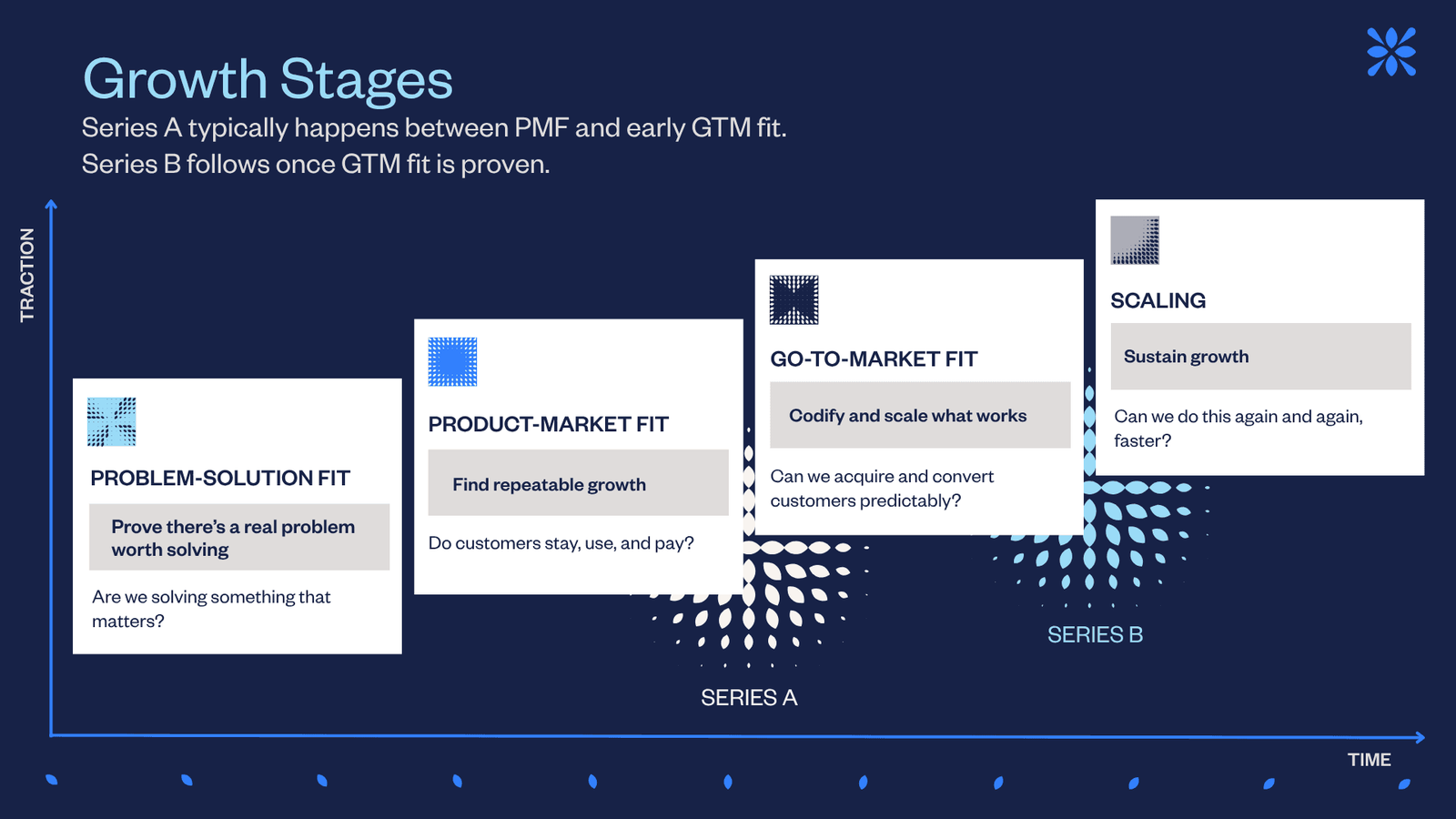
1. Problem–solution fit
At this first stage, the goal is to validate the problem and confirm that the product being built addresses it. There might be a handful of early adopters, often from the founder’s network. The focus is on shipping, testing, iterating, and learning fast.
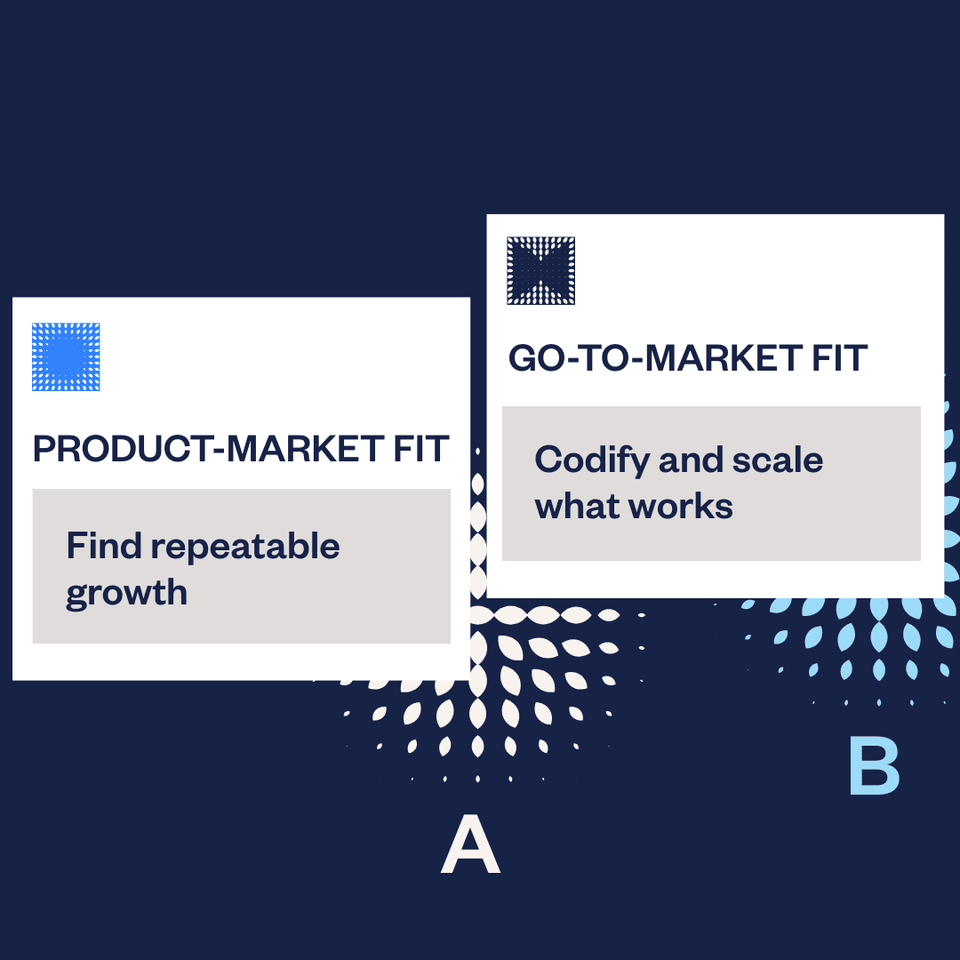
2. Product–market fit (PMF)
The company’s product delivers clear value and customers are coming back. Demand, adoption and retention starts to show consistency and sales efforts feel less like a push from the vendor and more like a pull from the buyer. However, in high velocity and innovation markets, PMF is not a single event, companies can gain and lose it as their markets evolve.
- Go-to-market fit (GTM fit)
This is when ICP, pricing, and sales motion begin to form a repeatable system. Acceleration starts in hiring, messaging, and pipeline-building. The GTM engine is taking shape, and at least one motion (e.g. outbound) is proving repeatable.
4. Scaling
The company is doubling down on what works: GTM efficiency metrics and quota attainment data provide comfort for more hires, more channels, more markets. With repeatable motions and strong funnel visibility, the focus shifts to execution. The machine is up and running. It’s time to accelerate.
So, what do we, as investors, look for at Series A and B? Here's a closer look.
Series A: “Show us your foundation”
Series A typically happens between PMF and early GTM-fit. It marks the transition from promising traction to early repeatability. At this stage, investors look for signs that the company is starting to build a GTM model that can scale.
A few indicators tend to stand out:
- Repeatability: At least one sales motion is active and starting to deliver consistent results, even if it's still founder-led.
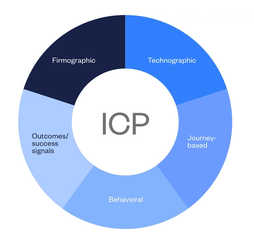
- Clear ICP: The pipeline is structured around a well-defined ideal customer profile and buyer personas, not scattered and opportunistic deals.
- Data tracking enablement: The team knows what to track, and has the tools in place to follow through: dashboards, BI, or ideally, a platform like Vasco.
- North star clarity: Leadership is aligned on what success looks like and can articulate the path to get there.
At Series A, it’s less about hitting targets and more about having the ability to showcase and measure velocity, momentum and progress towards true GTM-fit.
Series B: “Predictability kicks in”
Series B comes once GTM-fit is proven, and the company is ready to scale. The playbook is clearer, and investors look for signs that the business is operating at steady state.
What VCs look out for:
- Less founder-drag: One or two sales motions are delivering, and no longer solely rely on the founder or their network to close deals and hit targets. Execution is team-led.
- Scalable hiring: The company has a firm grip on sales capacity and execution, knows which sales profiles tend to succeed, how to hire them, and how long it takes for them to ramp.
- Codified onboarding: Sales enablement is structured. New hires follow a repeatable path to productivity, with clear playbooks and systems.
- Performance benchmarks: Metrics are no longer directional. They’re used to manage performance and guide decisions.
This round is typically about acceleration. Investors come in to fuel a recipe that’s already working.
An example from the field: Zaddons road to Series A
Zaddons builds specialized solutions that enhance human resource information systems (HRIS), focused on complex bidding and scheduling. Co-founder Sébastien Massicotte had previously led an HRIS consultancy, where he repeatedly saw the same acute pain point, giving the team a head start on problem–solution fit.
After raising a Seed+ round in Q2 2024 (with Framework participating), the company validated product–market fit through growing founder-led sales. Over the following 12 months, several GTM-fit signals began to emerge:
- Clear ICP and buyer personas: HR and Ops leaders in mid- to large-sized healthcare, manufacturing, and logistics companies
- Strong and accelerating lead-to-SAL conversions
- Early traction with a second motion via partnerships with HRIS vendors and system integrators (SIs)
- Sales hiring playbook taking shape: defined AE and sales leadership profiles, with onboarding and performance tracking frameworks ready
“We had validated market fit. Demand was accelerating and outpacing our lean sales setup. Scaling became a necessity—not to grow faster, but to stop leaving revenue on the table.” — Louis-Sébastien Laprise, co-founder @ Zaddons
Zaddons is now approaching GTM-fit and in good shape to raise Series A, with the right motion, in the right markets, and the systems to scale it.
Wrapping up: maturity is a signal, not a score
Early-stage teams are often experts in the problem they’re solving. But go-to-market is a discipline of its own, and one that can make or break the business.
Beyond growth, understanding how to build, test, and scale your GTM strategy allows you to raise capital, allocate resources, and turn a great product into a viable company.
Investors are looking for direction and results, of course. But even more so, the ability to generate them again and again.
Maturity is evaluated by the ability to know what matters now, and what to build next.